Brand Group Core with solid results – special items impact Volkswagen Brand
Published By Volkswagen [English], Wed, Apr 29, 2026 6:00 PM
At the Volkswagen Brand, the product mix and import tariff burdens had a negative effect on the result. In addition, costs in connection with the discontinuation of ID.4 production in the USA had an adverse impact. This had the largest effect on the result for the quarter. Škoda Auto recorded strong developments in sales, margin and cash flow, improving its operating margin to 8.3%. SEAT&CUPRA increased profitability to 1.2%. Volkswagen Commercial Vehicles boosted its margin to 3.9%. Net cash flow in Q1 was -53 million euros as a result of the usual seasonal effects on net current assets. In core business, operational cash flow generation remained robust. After eliminating the model-specific impairment at the Volkswagen brand, the Brand Group Core consistently continued its path to margin improvement and cost discipline.
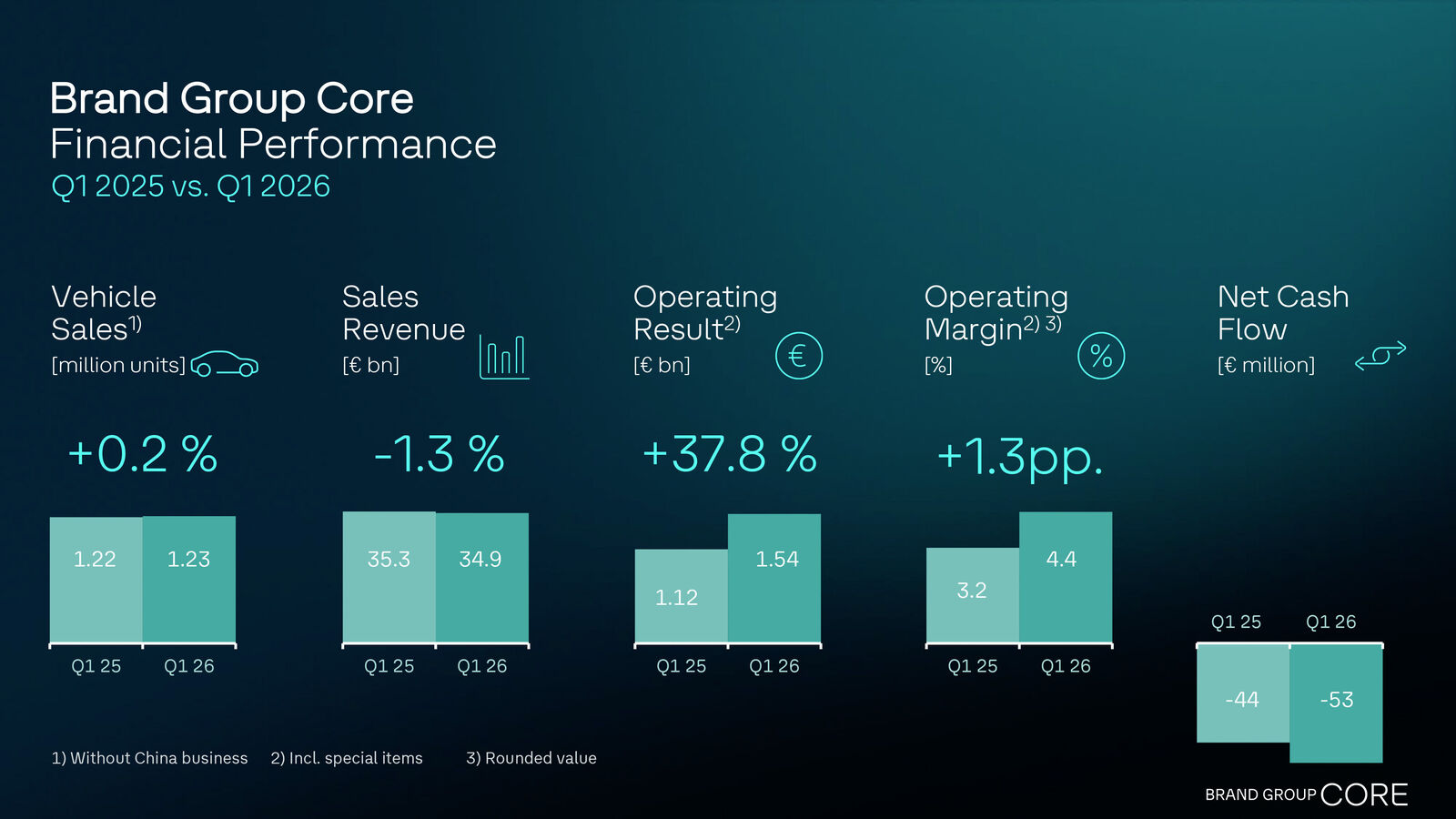
The Brand Group Core (BGC), the organizational entity combining the volume brands of the Volkswagen Group, closed the first quarter of 2026 with an operating result of 1.54 billion euros. Sales ran at 34.9 billion euros, and the operating margin was 4.4%. Compared with the prior-year period, unit sales rose moderately to 1.23 million vehicles. The development of results across all the brands of the Brand Group Core was buoyed by optimized product costs and consistent cost management. The negative impact of lower volumes in China and the USA was compensated for – bearing witness to sustained progress with efficiency measures.
In the first quarter, the Brand Group Core recorded solid performance in a challenging environment. If we eliminate the costs in connection with the discontinuation of ID.4 production in the USA, the operational development in the first quarter was generally positive – bearing witness to the progress achieved with margins and cost discipline. However, we are still not earning enough to sustainably finance our future. Consistent cost controlling and operational performance therefore remain our top priorities.
David Powels, CFO Volkswagen Brand & Brand Group Core
Brand Group Core Key figures (January – March 2026)
| Unit sales of Brand Group Core grew to 1.23 million vehicles (Q1 2025: 1.22 million vehicles) | Compared with the prior-year figure, there was moderate growth of 0.2% in unit sales. |
| Sales revenue fell by 1.3% to 34.9 billion euros | The slight fall in sales revenue reflects the challenging market environment. Škoda achieved a significant increase thanks to strong European business.|
| Operating result of | The operating result improved significantly by about 38%. The efficiency measures initiated are gaining traction.|
| Operating margin of Brand Group Core 4.4% | The operating margin of 4.4% chiefly reflects the higher US import tariffs, restructuring costs and costs in connection with the discontinuation of the ID.4 in the USA, but is above the figure for the previous year. Without the restructuring expenses and the ID.4 production stop, the operating margin of BGC would|
| Net cash flow fell to | In the first quarter of 2026, net cash flow was -53 million euros due to the usual seasonal effects on net current assets, roughly corresponding to the prior-year figure.|
The Brand Group Core continues its approach of consistent efficiency improvement and cross-brand cooperation. The restructuring of the Brand Group Board of Management implemented in January 2026 laid the organizational groundwork for shortening decision-making paths, streamlining structures and sustainably improving the competitiveness of the Brand Group.
With the launch of the Electric Urban Car Family in 2026, the Brand Group Core will be launching four electric models in the compact segment. Under the project management of SEAT/CUPRA, two models of the Volkswagen brand and one model each of CUPRA and Škoda are being created at the Spanish sites in Martorell and Pamplona.
Although these models have been developed jointly, their design, positioning and customer appeal are clearly differentiated. The models show that upscaling does not mean compromise but rather affordable e-mobility and a strong brand presentation. Across the entire product life cycle, the Electric Urban Car Family will leverage synergy potential of 650 million euros.
Volkswagen Passenger Cars is approaching the launch of the broadest electric model portfolio in the history of the brand. In 2026, we will see the world premiere of the ID. Polo, ID. Polo GTI, ID. Cross and the ID.3 GTI - and thus complement the recently introduced ID.3 Neo. Especially the ID. Polo will break new ground as regards affordable e-mobility in the compact segment. All the models are based on the latest stage of development of the Modular Electric Drive Toolkit, the MEB+, a technology previously reserved for larger vehicle classes, which will now be available for the first time in the small car class. The model offensive as a whole represents the strategic reorientation of the brand: quality, value and technical expertise lay the foundation for the democratization of e-mobility.
In the USA, Volkswagen has discontinued local production of the electric ID.4. Instead, the Chattanooga plant will focus on high-volume internal combustion engine models such as the Volkswagen Atlas. The resulting costs in the amount of 0,5 billion euros reflect the adjustment of the local product strategy to changed market conditions.
At the same time, the business model of the Volkswagen Group is being realigned. The new vision for 2030 takes up the current challenges resulting from a rapidly changing environment. The product portfolio will be further streamlined, as will structures and processes. The focus is on those platforms and technologies that will make a perceptible difference for the customer.
In addition, responsibilities at all levels need to be even more clearly defined. Clear competences for the Group, brands and regions will make decisions faster and more reliable. Resources will be channeled in a disciplined way to areas where competitiveness and added customer value can be created.
Overview of the brands in the Brand Group Core
Volkswagen Passenger Cars sold a total of 715,984 vehicles (excluding China, including external manufacturing) in the first quarter, representing a fall of 1.4% compared with the figure for the first quarter of 2025. The generally difficult market environment had a negative impact. At 19.9 billion euros, sales revenue was 6.3% below the figure for Q1 2025. The operating result after special items ran at 73 million euros, slightly below the prior-year figure of 112 million euros.
Key factors included costs in connection with the discontinuation of ID.4 production at Chattanooga, US import tariffs and restructuring costs. The operating margin after special items was 0.4%. Without the restructuring expenses and the costs in connection with the ID.4, the margin of the Volkswagen Brand in Q1 would be 3.5%.
Models such as the T-Cross and Tayron developed satisfactorily in the first quarter – with our new ID. models, we are now launching attractive entry-level vehicles and
At the same time, we are confronted by the realities of the marketplace in the USA. These have a significant negative impact on our profitability and make it clear that consistent action on costs and further efficiency improvements are necessary. “
David Powels, CFO Volkswagen Brand & Brand Group Core
Volkswagen Commercial Vehicles
In the first quarter, Volkswagen Commercial Vehicles delivered about 88,900 vehicles to customers, representing growth of about 10% compared with the first quarter of 2025. We were able to further increase the share of all-electric vehicles. Key drivers in this development were the New Transporter and the significant growth in sales of the ID.Buzz in Europe. With a market share of 21.9%, Volkswagen Commercial Vehicles remains a clear market leader in the BEV segment. In contrast, unit sales, at 99,000 vehicles, were 8% below the prior-year figure.
As a result of the lower volume, sales revenue also fell to 3.9 billion euros (Q1 2025:4.1 billion euros).
Progress with costs led to a significant improvement in the result. The brand's operating result grew to 154 million euros (Q1 2025:37 million euros) and the operating margin improved to 3.9% (Q1 2025:0.9%).
In the first quarter, we held our own in an intensely competitive environment, with an increase in deliveries of about 10% in deliveries. The successful launch of new models and the strong development of our electric vehicles confirmed that we are on the right track. We continued to focus on cost discipline, efficiency and strategic development and were therefore able to significantly improve our operating result.
Michael Obrowski, Member of the Volkswagen Commercial Vehicles Board of Management, responsible for Finance & IT
In the first quarter of 2026, SEAT & CUPRA achieved progress towards sustainable growth and recorded an operating result of 43 million euros between January and March – an increase of 38 million euros compared with the first quarter of the previous year. The financial recovery was driven by disciplined reductions in product and indirect costs, the consistent implementation of the performance program and the fact that the CUPRA Tavascan was not subject to additional EU tariffs. CUPRA is maintaining its momentum and reported the best quarter ever for deliveries, with a total of 79,800 vehicles delivered. March was also the best delivery month ever, with 36,300 vehicles delivered. Looking to the future, this performance underscores confidence in the forecast for the year, with additional impetus for the coming quarters as the new CUPRA Born, the updated CUPRA Tavascan and the CUPRA Raval are to be launched.
"Our Q1-performance demonstrates SEAT & CUPRA’s resilience and determination. In a highly competitive and challenging market environment, we are delivering tangible results thanks to our Performance Programme.
We have a clear plan and are executing on it by reducing direct costs associated with product costs, as well as our fixed cost base.
At the same time, CUPRA’s record results, and the upcoming model launches in 2026 give us confidence for the full year.”
Patrik Andreas Mayer, Member of the SEAT & CUPRA Brand Board of Management, responsible for Finance and IT
In the first quarter of 2026, Škoda Auto continued the strong development of the past few years. Global unit sales grew by 13.9% to 314,611 vehicles. Sales revenue rose by 9.1% to 7.9 billion euros. The operating result was up 20.9% to 660 million euros.
With an operating margin of 8.3%, compared with 7.5% in Q1 2025, Škoda Auto reinforced its position as a high-margin brand. The consistent implementation of the Next Level Efficiency+ program and a favorable model mix played a key role in this development.
"Our solid first-quarter financial performance demonstrates the disciplined way in which we are managing the business. Strong revenue growth was combined with very solid profitability, confirming the effectiveness of our approach. The return on sales remains at a very healthy level, while the strong increase in net cash flow underlines the company's stability. This financial strength reinforces our resilience in a phase of major transformation.
Supported by substantial synergies across the Volkswagen Group and the Brand Group Core, Škoda Auto is well positioned to meet future challenges from a position of confidence."
Holger Peters, Member of ŠKODA Auto Brand Board of Management, responsible for Finance, IT and Legal Affairs
Key figures for the Brand Group Core :
Unit sales (thousand units including vehicles of other brands)
Key figures for the brands belonging to the Brand Group Core:
Volkswagen Commercial Vehicles
1) Also includes sales to sales companies including other Group brands
Press release distributed by Wire Association on behalf of Volkswagen, on Apr 29, 2026. For more information subscribe and follow Volkswagen
