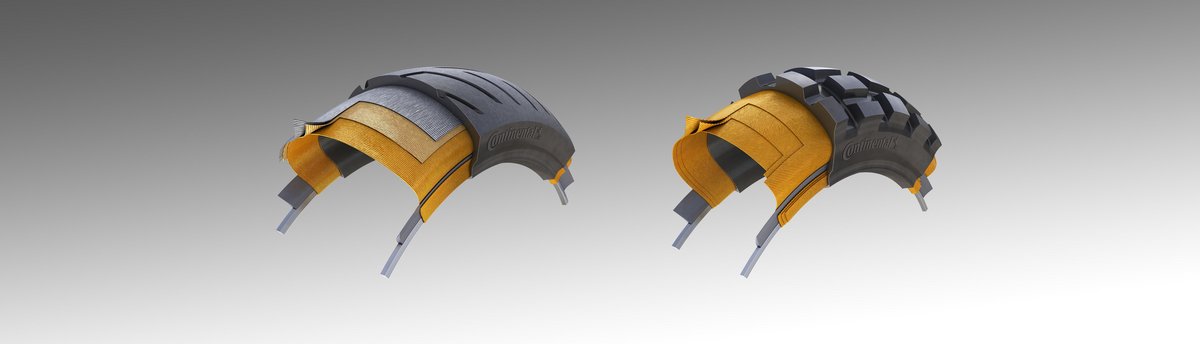
Radial and Diagonal Tires Compared – Areas of Application, Advantages, and Needs
Published By Continental AG [English], Wed, Jan 28, 2026 6:00 PM
Both design principles share the global tire market
- Radial tires dominate the market for modern road motorcycles
- Diagonal tires are the first choice for light motorcycles and off-road use
Hanover, Germany, January 29, 2026. Around 40 years ago, radial tires helped motorcycles reach new levels of performance and speed. Today, they account for approximately 46 percent of global sales[1]. However, diagonal tires continue to have a wide range of applications, which is why modern versions of both design principles will still be part of Continental’s portfolio in 2026. Continental Motorcycle Tires product developers, Rafael Kascha and Sergio Pannain, explain the most important differences.
What is the fundamental difference between radial and diagonal tires in terms of their construction?
Rafael Kascha: The fundamental difference lies in the arrangement of the carcass plies. In diagonal tires, the fabric plies run at an angle – i.e. diagonally to the direction of travel, and across each other. This construction makes the carcass stiffer overall, but also less dimensionally stable at high speeds. Radial tires, on the other hand, have carcass plies that run radially, i.e. from the centre of the tire outwards. Above these are belt layers, usually made of steel, which provide additional stability. These steel belt layers prevent the circumference of the tire from increasing at high speeds. With diagonal tires, this circumferential growth can be up to several centimetres.
What does this mean for the respective riding characteristics?
Sergio Pannain: Diagonal tires offer high inherent stability and are particularly robust against external influences such as potholes or curbs. However, at higher speeds, instability can occur because the carcass is subjected to greater stress and the tire deforms more.
We have been familiar with radial tires since the 1980s, when the first motorcycles with over 100 hp came onto the market. They score points with their significantly higher dimensional stability – even at high speeds. They also enable more precise handling, offer better feedback and more grip, both in dry and wet conditions. Today, they are state of the art, especially in the sports sector and on modern motorcycles.
For which motorcycles and areas of application is each tire technology recommended?
Rafael Kascha: Diagonal tires are still the first choice for many classic motorcycles and youngtimers, as these motorcycles are often approved only with this type of construction and the tires are adapted to the frame and chassis design of older bikes. Their robust properties can also be an advantage on very poor roads or off-road tracks – for example, on heavy adventure bikes on a round-the-world trip. In classic enduro and the off-road sector, diagonal tires remain the standard, as they are particularly resistant to impacts and allow riding with low air pressure, which significantly improves grip on loose or soft surfaces.
Radial tires, on the other hand, are mainly used on modern motorcycles and sporty models. Their advantage is particularly evident on well-maintained roads, at higher speeds, and when precise handling, short braking distances, and maximum lean angle stability are important. Riders also benefit from comfort and safety in everyday use, especially in changing weather conditions.
Furthermore, it is a strength of our portfolio that Continental also offers radial tires for classic motorcycles and youngtimers. ContiClassicAttack and ContiRoadAttack 3 CR are product lines that enable these bikes to benefit from state-of-the-art tire technology as well.
How can you tell the difference between diagonal and radial tires?
Rafael Kascha: Actually, you can’t tell the difference from the tread. However, the distinguishing feature of radial tires can be found in the size designation on the tire sidewall. The ‘R’ in the designation, e.g. 180/55 ZR 17 or 110/80 R 18, indicates that it is a radial tire. Diagonal tires, on the other hand, are identified by a hyphen in the size designation, such as current metric sizes like 140/80-17 or older inch sizes such as 4.00-18.
What about motor scooters? Are both technologies used there?
Sergio Pannain: Yes, both technologies are used on scooters. Diagonal tires are still widely used on classic or smaller scooters because they are robust, comparatively inexpensive, and sufficient for lower speeds and lighter weights. In the premium and maxi scooter segment, i.e. for more powerful, faster scooters, radial tires are used most. Here, too, they offer the advantages of better handling, greater riding comfort, and increased stability at higher speeds – for example, in city traffic, on expressways or highways.
Are there any disadvantages to either type of construction?
Sergio Pannain: Yes. Diagonal tires are robust but offer less riding precision and can become unstable at high speeds. Heat dissipation is also poorer, which can lead to problems on long, fast journeys. Radial tires are more complex in design and usually require a modern chassis for optimum handling. They are not approved for some classic bikes or do not fit due to their dimensions.
What does the future hold? Will radial tires completely replace diagonal tires?
Rafael Kascha: Today, radial tires clearly dominate the market for modern road motorcycles. Nevertheless, there will continue to be a need for both technologies, as requirements vary greatly depending on the motorcycle, scooter, and area of application. Continental therefore develops tires specifically for both types to offer all riders the optimal solution.
[1] https://www.globalgrowthinsights.com/de/market-reports/motorcy.... These figures also include lightweight motorcycles and scooters sold in Asia, South America, and Africa. With modern road motorcycles, radial tires play a clearly dominant role.
Press release distributed by Wire Association on behalf of Continental AG, on Jan 28, 2026. For more information subscribe and follow Continental AG