Launch of EU funded MONALISA Project to Combat Land Degradation and Desertification in Mediterranean Arid Areas
Published By MONALISA project [English], Sun, Oct 18, 2026 1:51 AM
Overview of the MONALISA project, Consortium and Kick-off Meeting organised in Sassari, Italy
Sassari, October 1st, 2024 – The MONALISA project (MONitoring and Assessing prevention and restoration soLutIons to combat deSertificAtion), an Innovation Action Horizon project aimed at preventing and reversing Land Degradation and Desertification (LDD) across Mediterranean drylands, has started with the Kick-off Meeting hosted by Università degli Studi di Sassari (UNISS) in Sassari, Italy. The project is funded under the Horizon Europe program under the topic HORIZON-MISS-2023-SOIL-01-04, with a total budget of € 7.325.993,75. The Granting Authority for this project is the European Research Executive Agency (REA), under the European Commission.
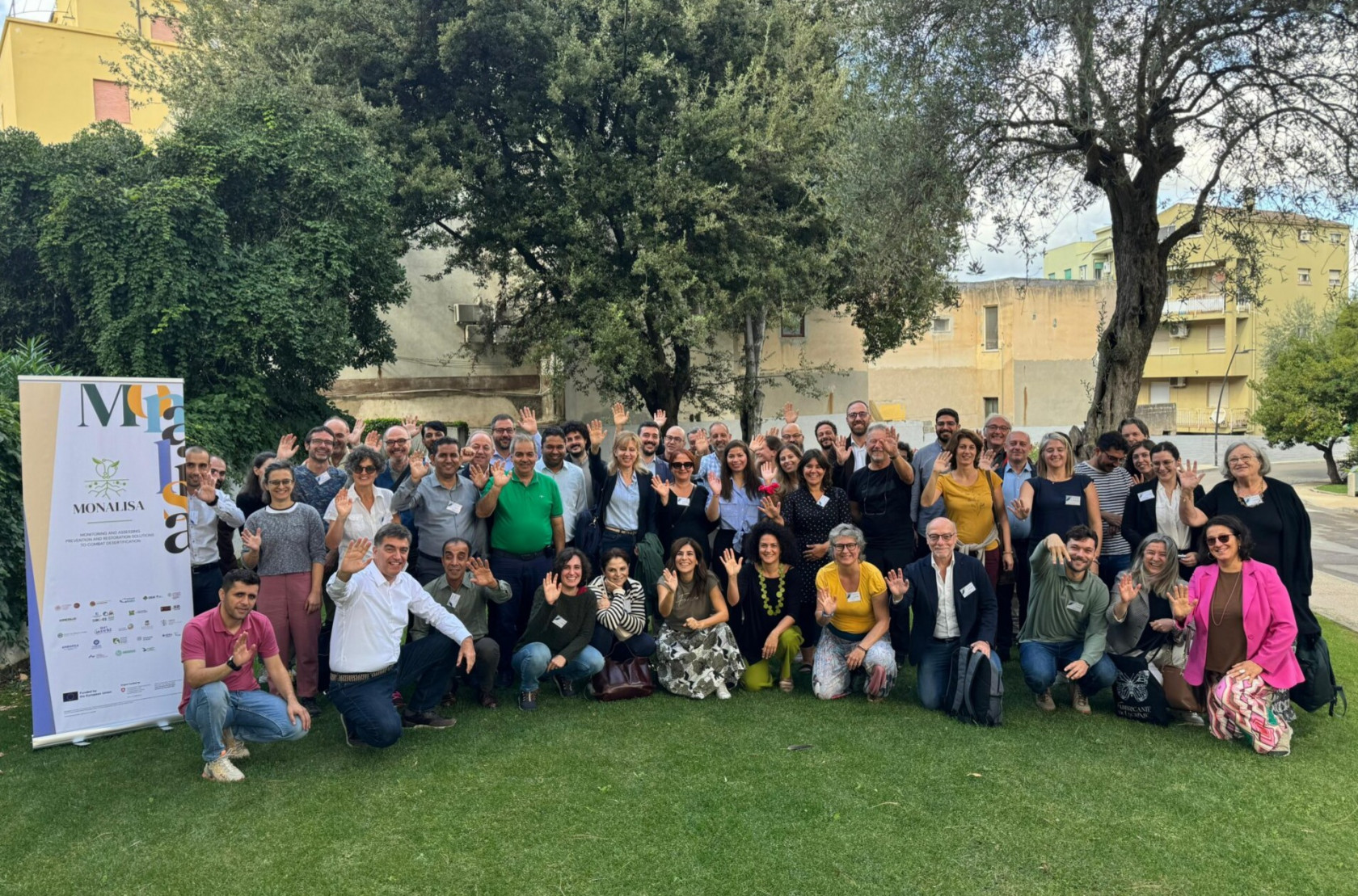
The Kick-off Meeting was held on October 1-3, 2024, in Sassari, Sardinia, Italy, hosted by the project coordinator, Università degli Studi di Sassari (UNISS). The event gathered the MONALISA Consortium to advance their mission of developing sustainable solutions for land degradation and desertification (LDD). The agenda featured presentations from work package leaders, highlighting the project’s comprehensive approach, which includes multidisciplinary research, field implementations, stakeholder engagement, and collaboration with other research initiatives and campaigns.
The MONALISA project is coordinated by the UNISS and involves a diverse MONALISA Consortium of 20 partners, 2 associated partners and 1 affiliated entity, from 9 countries, including 13 research institutions from Italy, Spain, Denmark, Greece, Tunisia, Romania, and Switzerland, emphasizing strong academic and scientific expertise. The consortium also involves 2 public authorities from Italy and Tunisia, which contribute governmental insights and support. Additionally, 3 NGOs from Spain, Greece, and Palestine, along with 2 civil society organizations (CSOs) from Italy and France, bring valuable grassroots and community engagement perspectives. Lastly, 3 SMEs from Italy, Spain, and Serbia, provide innovative and entrepreneurial approaches to project topic.
The MONALISA project addresses the pressing issue of LDD through innovative, tailored solutions. These solutions will be assessed and scaled out across six Mediterranean case studies (CSs) Los Pedroches (Spain), Médenine (Tunisia), Alta Murgia Park (Italy), Berchidda-Monti (Italy), Asterousia (Greece) and Beit Dajan (Palestine). These CSs encompass various regions with different levels of aridity and socio-ecological conditions, aiming to combat land degradation and desertification through innovative and tailored solutions. The MONALISA project will integrate scientific and local knowledge through a transdisciplinary approach, engaging multi-sector stakeholders and interdisciplinary researchers in order to prevent and reduce LDD.
The main objective of MONALISA is to identify and promote effective solutions to combat LDD, showcasing their socio-economic and environmental benefits. The project will focus on several innovative practices, including adaptive multi-paddock grazing systems, microbial-based solutions, conservation agriculture practices, ecological restoration practices, water harvesting techniques, and the reuse of treated wastewater in agriculture. One of the primary outputs of the MONALISA project will be a multi-modular, practice-oriented Decision Support System (DSS). The DSS system will leverage advanced data and technologies, including remote sensing and artificial intelligence, to support sustainable and environmentally friendly solutions for LDD.
The MONALISA project started on September 1st, 2024, and will end on August 31st, 2028. Over these 48 months, the project aims to foster new business opportunities and promote public and private investments in sustainable solutions, contributing to the economic growth and environmental sustainability of European and Mediterranean arid areas.
MONALISA Consortium
Universita Degli Studi Di Sassari (UNISS); Universita Degli Studi Di Roma La Sapienza (Sapienza); Panepistimio Kritis (UoC); Centro De Investigacion Ecologica Y Aplicaciones Forestales (CREAF); Hellenic Society For The Protection Of Nature (HSPN); Ethniko Kentro Erevnas Kai Technologikis Anaptyxis (CERTH); Istituto Superiore Per La Protezione E La Ricerca Ambientale (ISPRA); Consiglio Nazionale Delle Ricerche (CNR); Institut Des Regions Arides (IRA); Centre International De Hautes Etudes Agronomiques Mediterraneennes (CIHEAM); Agricolus Agritech Spain Sl (Agricolus); Fondazione Medes (MEDES); We World-Gvc Organizzazione Non Lucrativa Di Utilita' Sociale (WeWorld); Aarhus Universitet (AU); Asociacion Adroches Para El Desarrollo Rural De La Comarca De Los Pedroches (ADROCHES); Universitatea Din Bucuresti (UniBuc); Inosens DOO Novi Sad (InoSens); Cooperativa Produttori Arborea - Societa Agricola (CoopArb); Ente Parco Nazionale Alta Murgia (AltaMurgia); Reseau Pour La Recherche Internationale Sur La Desertification (DNI); Commissariat Regional Au Developpement Agricole De Medenine (CRDA); Universitat Basel (UNIBASE); Universite De Geneve (UNIGE).
For more information, please reach out to:
Giovanna Seddaiu, Project Coordinator, [email protected]
Maja Sremački, Dissemination & Communication Manager, sremač[email protected], [email protected]
Press release distributed by Wire Association on behalf of MONALISA project, on Oct 18, 2026. For more information subscribe and follow MONALISA project
Diss & Comm Project Manager
[email protected]
+381213016964
Responsible for crafting and executing strategies to promote a project’s activities, findings, and results to a wide range of stakeholders, from the general public to specialized experts, ensuring that project results are not just produced, but used, maximizing the project’s overall impact.


